

Why Montessori Classrooms Are Multi-Age by Design
Walk into a Montessori classroom and one of the first things you may notice is that children of different ages learn together. For families accustomed to traditional schools, this raises an immediate question.
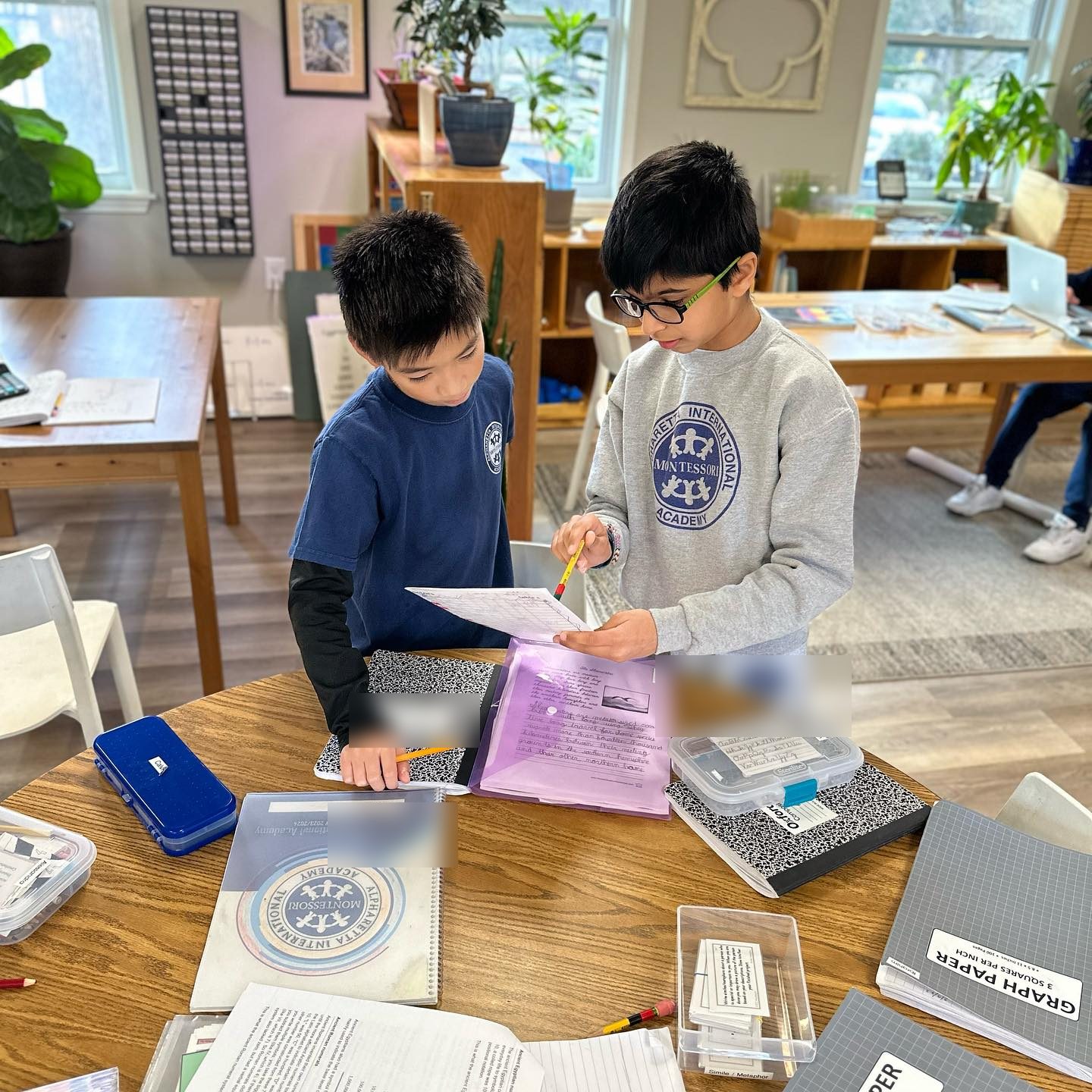
In a Primary classroom, you might see a three-year-old working beside a six-year-old. In Elementary, younger students learn alongside older students.
Why are children grouped with different ages instead of being separated by grade?
The answer is simple. Because real life does not separate people by birth year. And some of the most important learning children do comes from one another.
A community, not just a classroom
Traditional classrooms are typically organized around a single age group. Montessori classrooms are organized around a learning community.
Children remain in the same community for several years, allowing relationships to develop naturally over time.
Instead of starting over with a completely new class each year, students become part of a stable environment where they know one another, understand expectations, and develop a sense of belonging.
This continuity creates a stronger and more supportive learning experience.
Younger children learn from older children
Young children are natural observers. They learn by watching.
In a Montessori classroom, younger students regularly observe older students reading, solving math problems, conducting research, leading discussions, and caring for their environment.
This creates powerful motivation. Children see what is possible. They begin imagining themselves accomplishing those same things in the future.
The classroom naturally provides role models every day.
Older children reinforce their learning
One of the best ways to learn something is to teach it.
When older students help younger classmates, they strengthen their own understanding. Explaining a concept requires clarity, patience, and confidence.
As children share knowledge, they deepen their mastery while developing leadership skills that will serve them throughout life.
The result is a classroom culture where learning is collaborative rather than competitive.
Leadership develops naturally
In traditional schools, leadership opportunities are often limited to a small number of students.
In Montessori, every child eventually becomes one of the oldest members of the community.
Children experience both sides of the relationship. They begin as younger students learning from others. Over time, they grow into mentors and leaders themselves.
This progression helps children develop empathy, confidence, responsibility, and a sense of service to others.
Learning happens at different rates
One of the challenges of age-based classrooms is that children do not all develop at the same pace. Some students are ready for advanced work earlier. Others benefit from additional time and practice.
A multi-age classroom creates flexibility. Students can move forward when they are ready while still receiving support where needed.
The focus shifts away from comparing children to their peers and toward supporting each child’s individual growth.
A more natural environment
Outside of school, people rarely spend their entire day with others who are exactly the same age.
Families, workplaces, neighborhoods, sports teams, and communities are all made up of people with different experiences and abilities. Montessori classrooms reflect this reality.
Children learn how to communicate with people of different ages, collaborate with others, ask for help, offer support, and contribute to a larger community.
These social skills are just as important as academic knowledge.
What this looks like at AIA
At AIA Montessori, our multi-age communities are intentionally designed to support both academic and social growth.
Younger students benefit from observing older peers. Older students develop leadership, responsibility, and confidence.
Guides carefully prepare lessons and learning opportunities that meet each child where they are while fostering a strong sense of community.
Over time, students come to understand that learning is not a competition. It is a shared journey.
The bigger picture
The purpose of a Montessori classroom is not simply to teach academic content. It is to help children become capable, confident, compassionate human beings.
Multi-age classrooms support this goal by creating an environment where children learn with one another, learn from one another, and grow together.
A younger child learns what is possible. An older child learns how to lead. And every child learns that they are an important part of a community.
That lesson may be one of the most valuable of all.
Questions families ask us.
Will my child fall behind if there are older children in the classroom?
No. Montessori guides individualize instruction and ensure that every child is challenged appropriately based on readiness and progress.
Do older children get held back by helping younger students?
Quite the opposite. Teaching and mentoring reinforce understanding while developing leadership and communication skills.
How long do children stay in the same classroom community?
Montessori programs are typically organized in multi-year cycles, allowing relationships and learning to deepen over time.
Why doesn't Montessori use traditional grade levels?
Montessori focuses on developmental stages and individual growth rather than moving all children through the same curriculum at the same pace.
Families throughout Alpharetta, Johns Creek, Milton, Cumming, Suwanee, and surrounding communities often ask these questions as they explore Montessori education. At AIA Montessori, we encourage families to visit our classrooms and see Montessori learning in action.
About AIA Montessori
AIA Montessori is a nonprofit Montessori school in Alpharetta, Georgia, serving children from 18 months through Grade 8. Since 1981, AIA has helped children grow into confident, capable, and compassionate learners through authentic Montessori education.
Related articles.
Is Montessori Academically Rigorous?
Mastery over memorization, and where the rigor actually lives.
Do Montessori Children Really Choose Their Own Work?
What freedom within limits really means in a Montessori classroom.
Why Montessori Doesn’t Rely on Grades, Tests, and Homework
How progress is measured when there is no red pen.
Children of different ages learn, lead, and grow together.
Visit AIA Montessori and experience firsthand how a multi-age community works.
Book a Tour